
Renovating or Moving Home With a Cat: Where Should Your Cat Stay?
The most important thing is not to assume that your cat can continue living in the house as usual while renovation or moving work is taking place.
Renovations and house moves often involve unfamiliar people coming and going, doors being opened repeatedly or left open while furniture and materials are carried through, loud construction noises, dust, and significant changes to the home environment.
For a cat that is used to a familiar space and routine, all of these changes can be stressful.
Some cats hide. Others may panic, run away from the noise, or try to escape from an unfamiliar situation.
At Everyday Cat Hotel, we have spoken with many cat owners who have experienced cats escaping or going missing during home renovations, repairs, or moving.
It is heartbreaking because these incidents are not always caused by careless owners.
Sometimes it only takes a few seconds—a contractor leaves a door open while carrying materials, someone moves a piece of furniture, or a sudden loud noise causes the cat to run.
Why Are Home Renovations Particularly Risky for Cats?
A home under renovation operates very differently from a normal household.
On an ordinary day, you probably know where your cat likes to sleep, whether they tend to wait near the front door, and when you need to check their location before opening a door.
Contractors, delivery staff, installers, and movers do not know your cat's habits in the same way.
Their job is to complete the work, not to keep track of where your cat is throughout the day.
This means several risks can occur at the same time.
1. Many Unfamiliar People May Be Coming and Going
During a renovation, your home may have contractors, builders, delivery staff, furniture installers, or other workers entering throughout the day.
Some cats will hide when strangers arrive.
Others may become frightened and suddenly run somewhere you do not expect.
The more people moving through the house, the greater the possibility that someone may open a door without realizing that your cat is nearby.
2. Doors May Be Opened Frequently—or Left Open
This is one of the biggest risks during renovation or moving.
When workers are carrying furniture, tools, building materials, or equipment, doors may need to remain open for several minutes at a time.
That is very different from a normal day when the front door might only be open for a few seconds.
For a frightened cat looking for somewhere to escape, even a short period with an open door can be enough for them to get outside unnoticed.
3. Construction Noise Can Frighten Cats
Drilling, hammering, cutting, breaking walls, moving furniture, and dropping tools can all be extremely unfamiliar sounds for a cat.
Some cats may hide and stay still.
Others may instinctively run away from the source of the noise.
If a door or exit happens to be open at the same time, the risk of escape becomes much greater.
4. Familiar Spaces May Suddenly Disappear
Furniture may be moved.
Rooms may be closed.
Doors may temporarily be removed.
Boxes may fill areas your cat normally uses, and familiar hiding places may no longer be available.
Cats often rely heavily on familiar surroundings, smells, and routines.
When those things change at the same time as strangers, noise, and constant activity, some cats can become significantly more stressed.
5. Dust, Tools, and Construction Materials Also Need Attention
Escape is not the only concern during renovation.
There may also be:
Construction dust
Small pieces of building material
Nails and screws
Sharp objects
Paint
Adhesives
Silicone or sealants
Cleaning products
Power tools and equipment
Cats should not be allowed to freely explore an active construction area, even if they normally never try to leave the house.
If Your Cat Must Stay Home During the Renovation
If the project is relatively small and you can completely separate your cat from the work area, keeping your cat at home may still be possible.
However, your cat should have a dedicated safe room.
They should not be allowed to roam freely around the house while contractors are working.
Create a Dedicated Safe Room
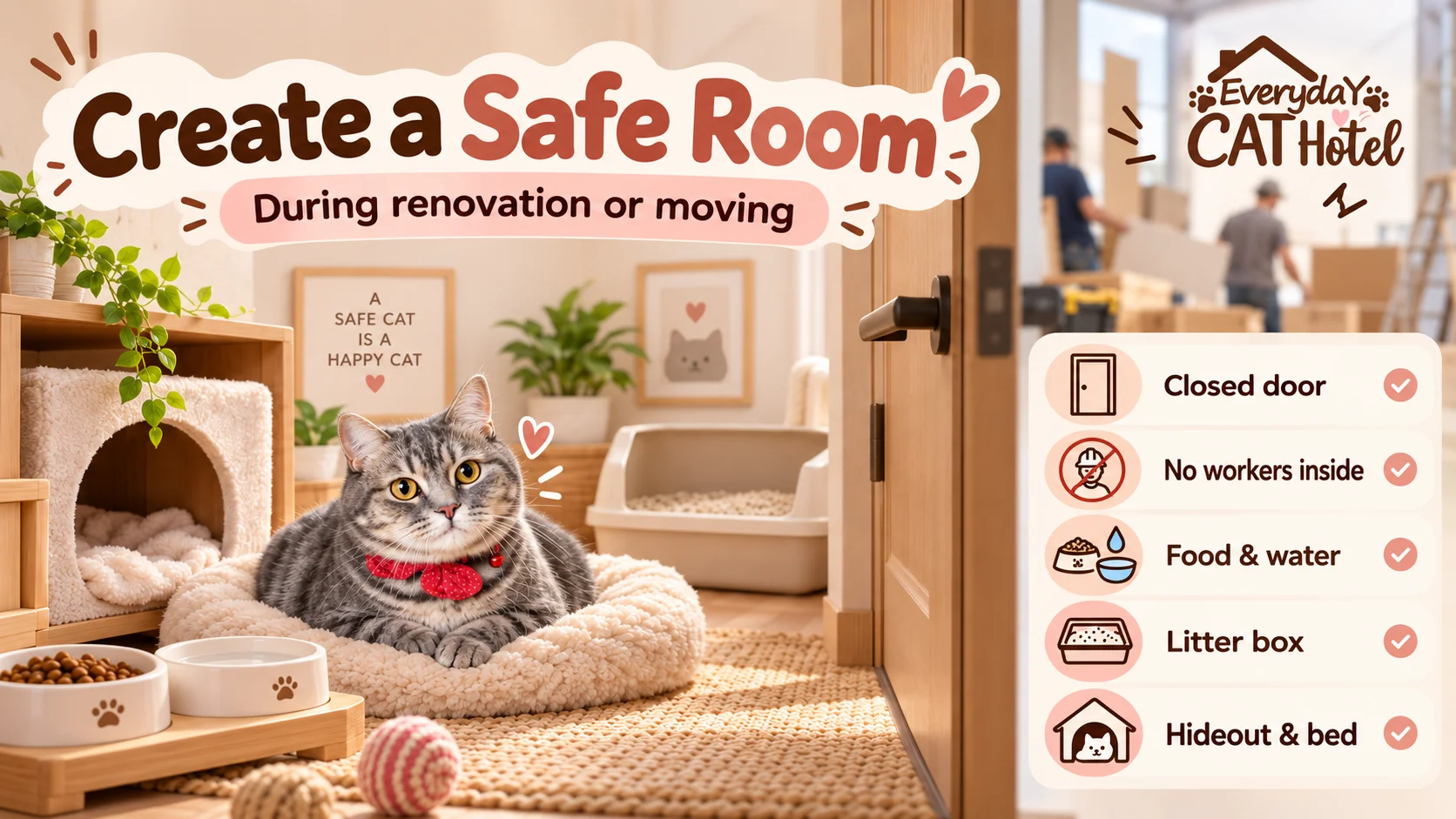
Ideally, the room should:
Have a door that closes securely
Be as far from the construction area as reasonably possible
Not require contractors to enter
Have food and fresh water
Have a litter box
Provide a comfortable place to sleep and hide
Include familiar bedding or items with familiar scents
Contain no construction materials or chemicals
While contractors are in the house, your cat should remain inside this controlled area.
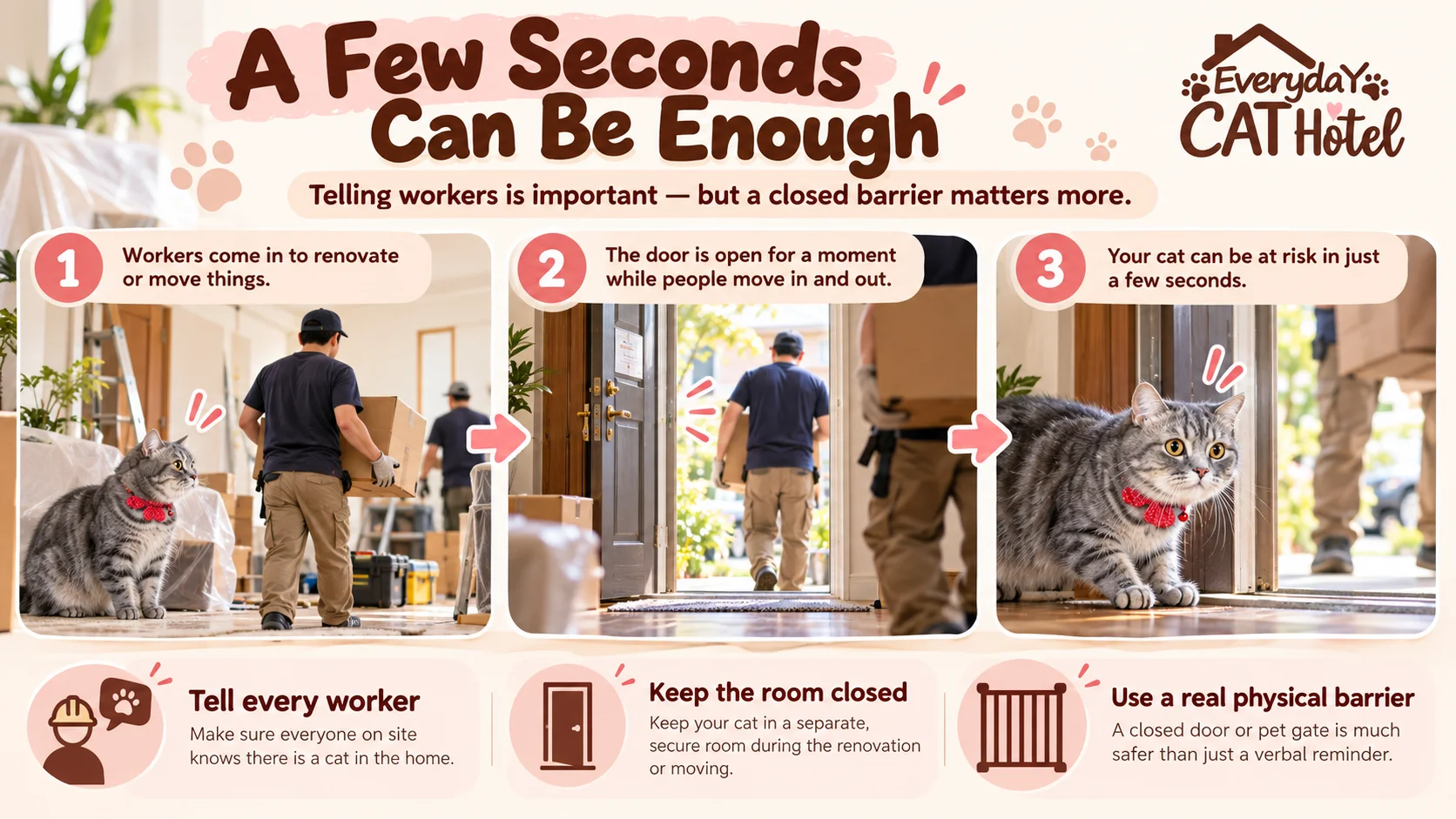
Telling Contractors About Your Cat Is Important—but It Is Not Enough
You should always tell contractors, movers, and anyone working in the home that there is a cat inside.
However, you should not rely on that warning alone to keep your cat safe.
Even when workers have been told that there is a cat in the house, their attention is naturally focused on the job they are there to do—carrying materials, using tools, installing equipment, or moving furniture.
They are not your cat’s owner, and they may not understand your cat’s habits or how quickly a cat can slip through an open door.
Someone may think:
“I’m only leaving the door open for a moment.”
But for a frightened or curious cat, a few seconds can be enough.
A contractor may also open a door without realizing that your cat has quietly moved closer to it, especially when several people are working at the same time.
That is why the safest approach is not simply to ask everyone to “please watch the cat.”
Instead, physically separate your cat from the work area in a secure room that contractors do not need to enter.
A clear sign on the door such as:
“CAT INSIDE — PLEASE DO NOT OPEN”
can provide an additional reminder, but the closed room itself should be the main layer of protection.
In other words:
Tell the workers—but do not make the workers responsible for preventing your cat from escaping.
Your cat’s safety should come from the way the environment is set up, not from expecting every person entering the home to constantly remember where the cat is.
Do Not Open Your Cat's Room While Furniture or Materials Are Being Moved
The beginning and end of the working day are often particularly busy.
People may be carrying tools and materials in and out, and exterior doors may remain open.
If you need to open your cat's safe room, first make sure that all doors leading outside are securely closed.
Avoid opening your cat's room while the main entrance is being used for moving materials.
Moving Day Requires the Same Level of Care
Even without construction work, moving day can create many of the same risks.
Doors are often left open while furniture is carried out.
Several people may be moving through the home at once.
And you may be managing many different things at the same time.
Instead of having your cat present during the entire move, it is usually easier to separate moving your belongings from moving your cat.
For example:
Keep your cat securely inside a closed room while the main move is taking place.
Wait until most of the furniture and boxes have been moved.
Place your cat securely inside their carrier before opening the room.
Take your cat directly to the new home.
Prepare one safe room at the new property first.
Allow your cat to become comfortable there before gradually exploring the rest of the home.
Your cat does not need to experience the busiest part of moving day.
What If There Is No Safe Room Away From the Renovation?
If the renovation is extensive, multiple contractors are coming and going, there is loud work throughout the day, or materials need to pass through the area where your cat would stay, keeping your cat at home may become difficult to manage safely.
In this situation, temporarily moving your cat somewhere else is worth considering.
Possible options include:
A family member's home
The home of someone your cat already knows
Another temporary space where access can be controlled
A cat hotel
The important point is not that a cat hotel is always necessary.
The goal is to choose an environment where doors, visitors, noise, and your cat's daily routine can be managed more reliably than in an active construction site.
How Can Cat Boarding Help During a Renovation?
For households that cannot create a secure space at home, temporary cat boarding separates the cat from construction noise, contractors, open doors, and the constant movement of materials.
Your cat can have their own accommodation while maintaining important parts of their normal routine, including:
Feeding
Rest
Litter box use
Daily care
Regular interaction and observation
They do not have to spend the day surrounded by drilling, moving furniture, or unfamiliar workers.
The boarding period also does not necessarily need to cover the entire renovation.
Some owners may choose to board their cat only during the most disruptive stages, such as:
Demolition
Drilling or breaking work
Particularly noisy construction
Moving large amounts of materials
Periods when exterior doors must remain open
Painting or work involving chemicals
Moving-in or moving-out day
Your cat can then return once the home becomes quieter and easier to manage.
The Renovation Is Finished—But Do Not Rush Your Cat Home
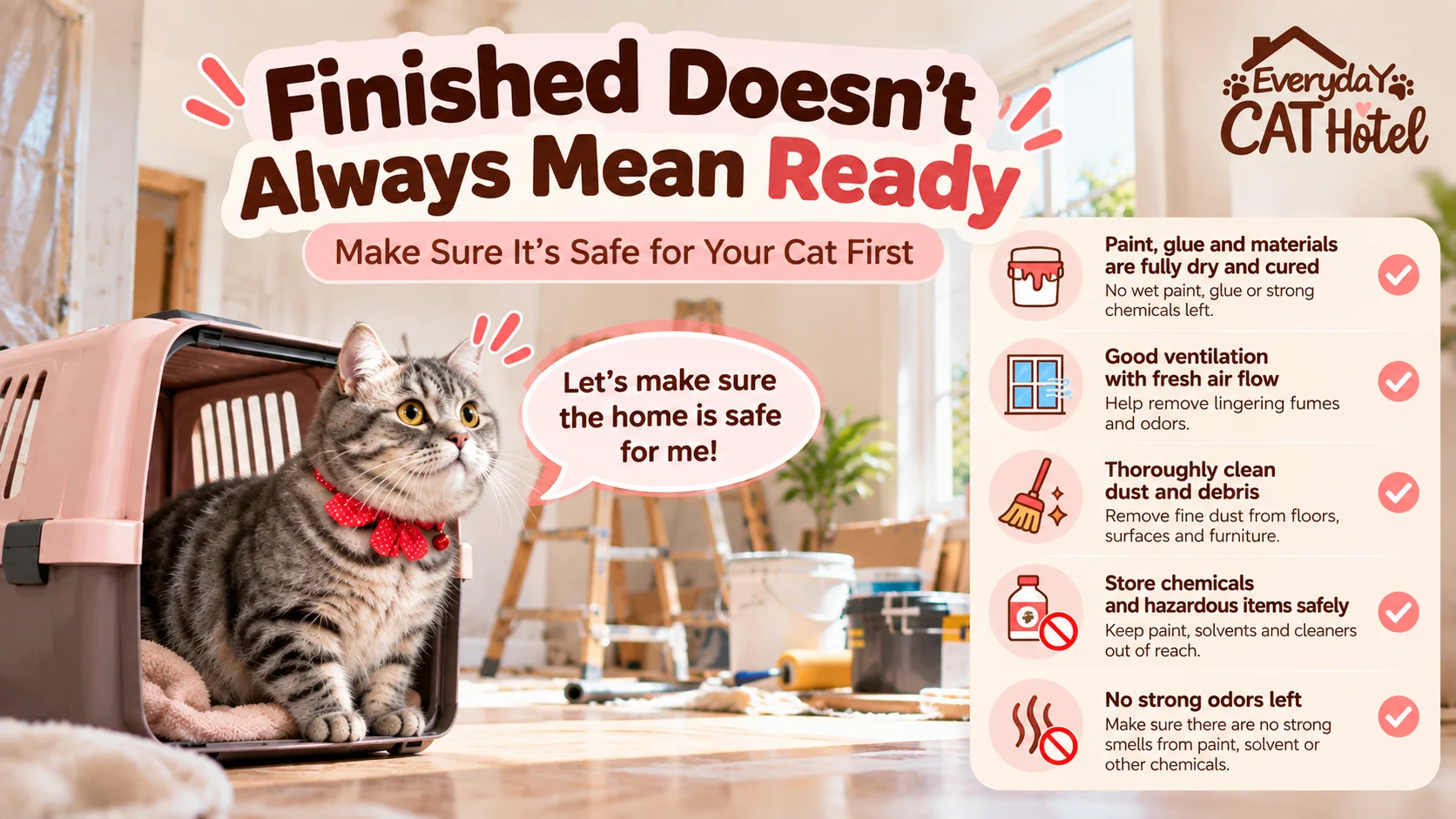
Another important issue is often overlooked:
“The contractors have finished” does not always mean “the home is ready for the cat.”
After renovation, the property may still contain:
Paint odors
Wood finishes or coatings
Adhesive smells
Silicone or sealant odors
Odors from new flooring or furniture
Cleaning products
Fine construction dust
Vapors released by some new materials
Some paints, coatings, adhesives, and building products can release volatile organic compounds, commonly referred to as VOCs, particularly after they have recently been applied or installed.
For this reason, if your home has just been painted, had new flooring installed, or involved the use of adhesives, sealants, coatings, or other chemicals, do not automatically bring your cat home as soon as the contractors leave.
Allow the home to ventilate properly and give products sufficient time to dry or cure according to the manufacturer's instructions.
Do Not Rely Only on Whether You Can Still Smell It
A reduction in odor is a positive sign, but smell alone should not be the only way you decide whether the home is ready.
Consider several factors together:
Have paints and other materials fully dried or cured according to their instructions?
Has the home been adequately ventilated?
Are there still strong odors in any rooms?
Has construction dust been thoroughly cleaned?
Have open containers of paint, glue, thinner, or cleaning chemicals been removed or securely closed?
Are floors and surfaces your cat may walk on, lie on, or lick clean?
Have relevant air-conditioning or ventilation areas been cleaned where necessary?
If the house still smells strongly of paint, glue, sealant, or other chemicals, there is usually no reason to rush your cat home.
If your cat is already staying somewhere safe, giving the house additional time to air out can be the more cautious choice.
Ventilate the Home After Renovation
After painting, flooring work, coatings, adhesives, or other materials that may release vapors, allow fresh air to circulate through the home as much as practical.
Depending on the property, this may include opening windows and safe exterior doors, using ventilation systems, or using fans to move indoor air outside.
Always follow the drying, curing, and ventilation instructions provided by the manufacturer of the products used.
There is no universal rule such as:
“After one day, it is safe.”
or
“After two days, the cat can return.”
The appropriate timing depends on factors such as:
The products used
The amount applied
The size of the space
Ventilation
Temperature
Humidity
Manufacturer instructions
If you are uncertain, allowing more time for drying, curing, cleaning, and ventilation before bringing your cat back is the more cautious approach.
Checklist Before Bringing Your Cat Home After Renovation
Do not feel that you need to bring your cat home immediately because the contractor says the project is finished.
Check the home first.
Demolition and loud construction work are complete
Large numbers of workers are no longer entering and leaving
Exterior doors no longer need to remain open for moving materials
Paint, adhesives, sealants, and other products have dried or cured appropriately
The house has been adequately ventilated
There are no strong renovation odors
Construction dust has been cleaned
Nails, screws, sharp objects, and debris have been removed
Paints, adhesives, chemicals, and cleaning products are stored where your cat cannot access them
Your cat's initial room can be securely closed
You have time to observe your cat after they return
If several of these points are not yet ready, there is no need to rush.
Boarding Your Cat During Renovation at Everyday Cat Hotel
Cats stay at Everyday Cat Hotel for many different reasons—not only because their owners are travelling.
We regularly see owners who need temporary boarding because they are repairing, renovating, moving home, or waiting for their accommodation to become ready.
Cats stay in private rooms, and cats from different households are not housed together in the same room.
The hotel also uses a double-door barrier system to help reduce the risk of cats escaping from the care area, and the hotel itself is located inside an enclosed building.
Our caregivers live in the same building as the cat hotel, so there is caregiver presence in the building during both the day and overnight.
Owners also receive regular photo and video updates during their cat's stay.
The aim is not simply to provide somewhere for your cat to stay while your home is being renovated.
It is to give your cat a more controlled environment during a period when their own home may be full of noise, unfamiliar people, open doors, dust, and constant change.
Before Renovating or Moving Home With a Cat: Quick Checklist
Before work begins, ask yourself:
Where will my cat stay while contractors are working?
Can that area be securely closed?
Will any contractors need to enter the room?
Will exterior doors need to stay open for long periods?
Will the work involve loud noise?
Will paint, adhesives, coatings, or other chemicals be used?
Who is specifically responsible for knowing where the cat is?
Where will my cat stay during moving day?
If my cat needs to leave temporarily, where will they stay?
How much ventilation time will the home need after the work is completed?
Planning for your cat before the contractors arrive is much easier than trying to solve the problem in the middle of a busy renovation.
Frequently Asked Questions
Can my cat stay at home during renovation?
In some cases, yes.
If you can provide a secure room completely separated from the construction area, and contractors do not need to enter that room, keeping your cat at home may be manageable.
However, it is not advisable to allow your cat to roam freely around the property while contractors are frequently entering, leaving, or opening doors.
Why are cats more likely to escape during renovation?
Renovations combine several potential triggers at once: unfamiliar people, loud noise, moving furniture, changing surroundings, and doors being opened far more frequently than usual.
A frightened cat may run through an open door before anyone realizes what has happened.
Can I simply ask the contractors to watch out for my cat?
You should definitely tell them that there is a cat in the home—but do not rely on contractors as your primary safety measure.
Even responsible workers are concentrating on their own tasks and may not understand how quickly a frightened cat can slip through a door that has been left open for only a few seconds.
They may also not recognize your cat’s usual behavior or notice that the cat has quietly moved closer to an exit.
The safer approach is to keep your cat physically separated from the work area in a securely closed room that contractors do not need to enter.
Informing the workers is an additional precaution. A secure physical barrier should be the main protection.
How long before renovation should I move my cat?
There is no fixed number of days.
If you plan to move your cat elsewhere, ideally do so before the disruptive stage begins—before demolition, loud work, heavy traffic through the house, or extended periods with open doors.
Do not wait until your cat is already highly stressed or has almost escaped.
Can my cat come home as soon as the renovation is finished?
Not necessarily.
First make sure that major work is complete, workers are no longer constantly entering and leaving, the property has been cleaned, materials have dried or cured properly, and the home has been adequately ventilated.
If there is still a strong smell of paint, adhesive, sealant, or other chemicals, it may be better to wait before bringing your cat home.
How many days should I wait after painting before bringing my cat back?
There is no single number that applies to every home or every product.
The appropriate timing depends on the paint or product used, the size of the space, the amount applied, ventilation, temperature, humidity, and the manufacturer's instructions.
Allow adequate ventilation and make sure products have dried or cured according to their instructions before bringing your cat back.
When should I move my cat into the new home?
If possible, bring your cat after the main furniture and boxes have been moved and after you have prepared a secure safe room.
This reduces the amount of time your cat spends around open doors and moving activity.
Can I board my cat while my home is being renovated?
Yes.
Home repairs, renovation, and moving are common reasons owners may choose temporary cat boarding, particularly when it is difficult to create a secure area away from construction.
Renovating or Moving Home?
If you are planning renovations, repairs, or a house move and are unsure where your cat should stay while contractors are working, you can send us your preferred dates, number of cats, and your cats' details.
The Everyday Cat Hotel team can help recommend a suitable room for their stay.
And if the construction work has finished but your home still smells strongly of paint, adhesives, sealants, or other renovation materials, there is no need to rush your cat home immediately.
You can plan your cat's check-out around when the home is genuinely ready for them.
LINE Official: @everydaycathotel
Everyday Cat Hotel
Cat boarding in central Bangkok for the times when home is not quite ready yet—giving your cat a more controlled place to stay while you manage your renovation or move.


