
First-Time Cat Boarding: Will My Cat Be Scared? How Cats Adjust During the First 2–3 Days
Yes, first-time cats can stay with us, and it is quite common for them to be cautious at the beginning — especially if they have never stayed at a cat hotel before.
When a cat arrives at a new place, they are suddenly surrounded by many unfamiliar things at once: a new room, new smells, new sounds, new people, and the absence of their usual family.
During the first 1–2 days, some cats may prefer to stay in the area where they feel safest, sleep or hide more than usual, show little interest in toys, or eat less at first.
From our experience at Everyday Cat Hotel, most cats begin adjusting to the environment and caregivers within approximately 2–3 days.
By around the third day, many cats begin eating better, exploring more, playing, and showing more of their usual personality.
Some cats who sit quietly in one corner on the first day become surprisingly playful once they feel comfortable.
We often joke that after the first three days, their mischievous side starts to come out.
Of course, every cat is different.
Some adjust within a few hours, while others may need more than 2–3 days.
What matters most is not rushing, not forcing interaction, and allowing each cat to adjust at their own pace.
Learn more about Everyday Cat Hotel and our care approach
Why Can Cats Feel Scared During Their First Boarding Stay?
Try looking at the experience from your cat’s point of view.
In a single day, they may go from their familiar home to a place filled with:
A new environment
A new room
Unfamiliar smells
Different sounds
People they have never met
Slight changes in routine
And no familiar family member nearby
For some cats, all of this happens at once.
So behaviors such as:
Sitting quietly
Hiding
Not wanting to play
Avoiding physical contact
Watching caregivers from a distance
Eating less at first
do not automatically mean:
“My cat cannot handle boarding.”
In many cases, these behaviors are simply part of how a cat observes and evaluates a new environment.
Once they begin to understand:
This room is safe.
This person brings my food.
No one is going to force me.
These sounds and smells are not dangerous.
their caution often begins to decrease naturally.
What Are the First 3 Days of Cat Boarding Usually Like?
From our experience at Everyday Cat Hotel, many first-time boarding cats follow a pattern similar to this.
It does not mean every cat will behave exactly the same way, but it can help cat parents understand what the adjustment period may look like.
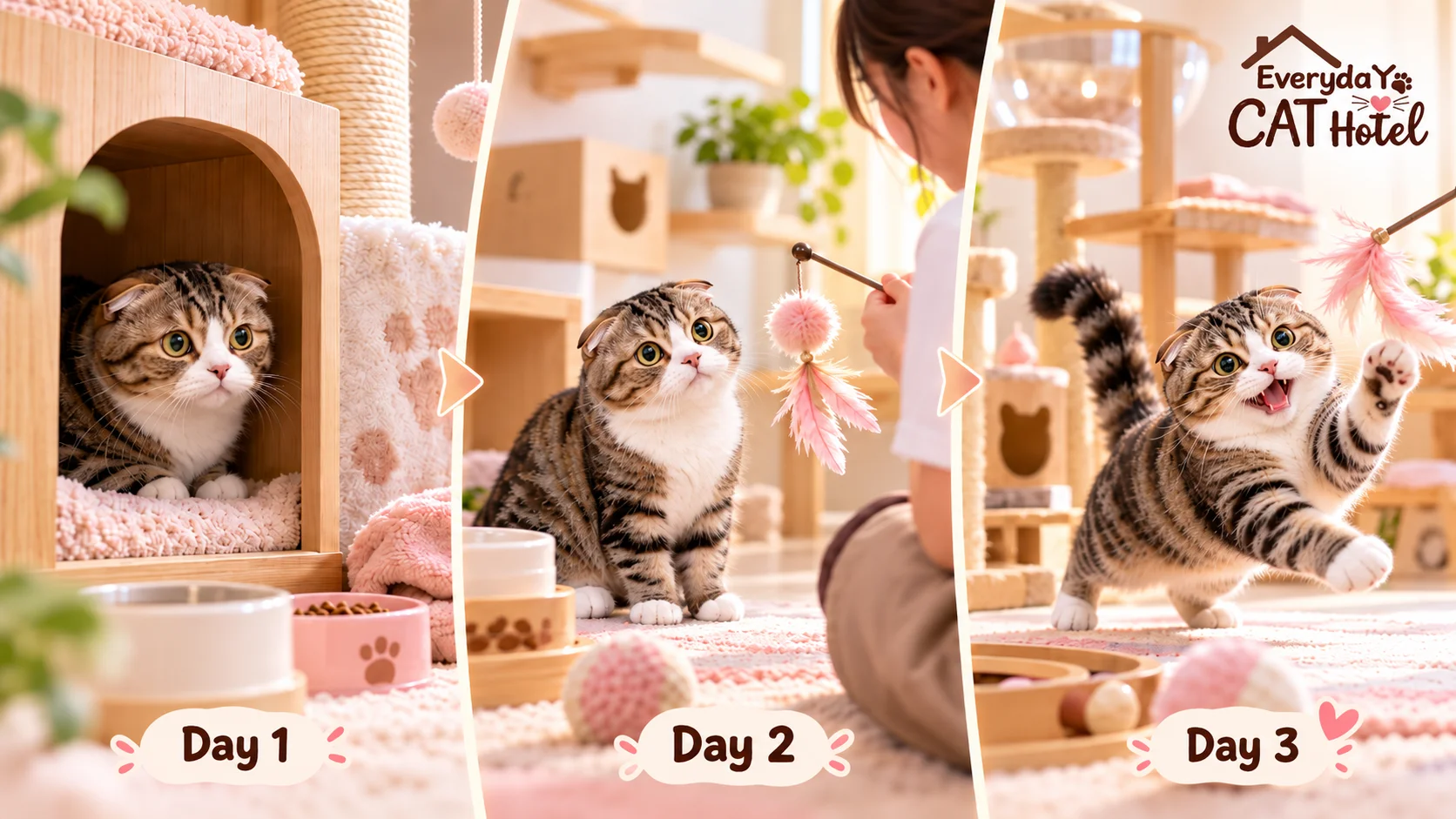
Day 1 — “Where Am I?”
The first day usually brings the greatest amount of new information.
Some cats may choose to stay in the area where they feel safest.
You may see behaviors such as:
Staying in one spot for a long time
Hiding in a secure corner
Not wanting to come out for Playtime yet
Showing little interest in toys
Not wanting caregivers to touch them
Eating less
Sometimes not eating immediately
Watching caregivers from a distance
For cats like this, caregivers do not need to rush them into playing.
The goal on the first day is not to make the cat become friendly as quickly as possible. It is to help them learn, “No one here is going to force me.”
Sometimes quietly sitting nearby without trying to touch the cat can be more helpful than constantly trying to interact.
Day 2 — Beginning to Observe and Learn the Routine
After the first night, the cat has already gathered more information about the environment.
They may begin noticing things such as:
When caregivers usually enter
What time food arrives
What people do inside the room
Which areas feel safe
Which sounds are part of the daily routine
On the second day, we often begin seeing small changes such as:
Coming out of hiding more often
Watching or approaching caregivers more closely
Responding to familiar voices
Showing interest in toys
Allowing people to come closer
Eating better
Exploring more of the room
Some cats may still be cautious, but their first-day fear often begins to soften.
Day 3 — “I Think I Know This Place Now”
For many cats, the third day is when more of their real personality begins to appear.
From our experience, many cats start to:
Eat more normally
Explore more confidently
Recognize caregivers
Allow closer contact
Play with toys
Come out for Playtime
Ask for attention
Show their playful or affectionate side
Some cats who watched us from the other side of the room on day one may be walking over to us by day three.
That is why we often say:
“Once they get through the first three days, the fun side starts to come out.”
How Do Caregivers Help Cats Get Used to the Hotel?
Everyday Cat Hotel does not use exactly the same approach with every cat.
Some cats enjoy being spoken to.
Some respond well to toys.
Some enjoy being petted.
Others feel more comfortable when we simply sit nearby and do not try to touch them yet.
For shy or cautious cats, our caregivers may begin by:
Sitting nearby
Speaking softly
Letting the cat observe and smell us first
Avoiding sudden attempts to touch
Not pulling the cat out of hiding
Not forcing Playtime
Introducing toys when the cat begins to show interest
Gradually petting or touching them when they are receptive
Increasing interaction as trust develops
The goal is not to make the cat bond with the caregiver as quickly as possible. The goal is to let the cat gradually decide that the people and environment are safe.
When the cat begins approaching us by choice, the relationship usually develops much more naturally.
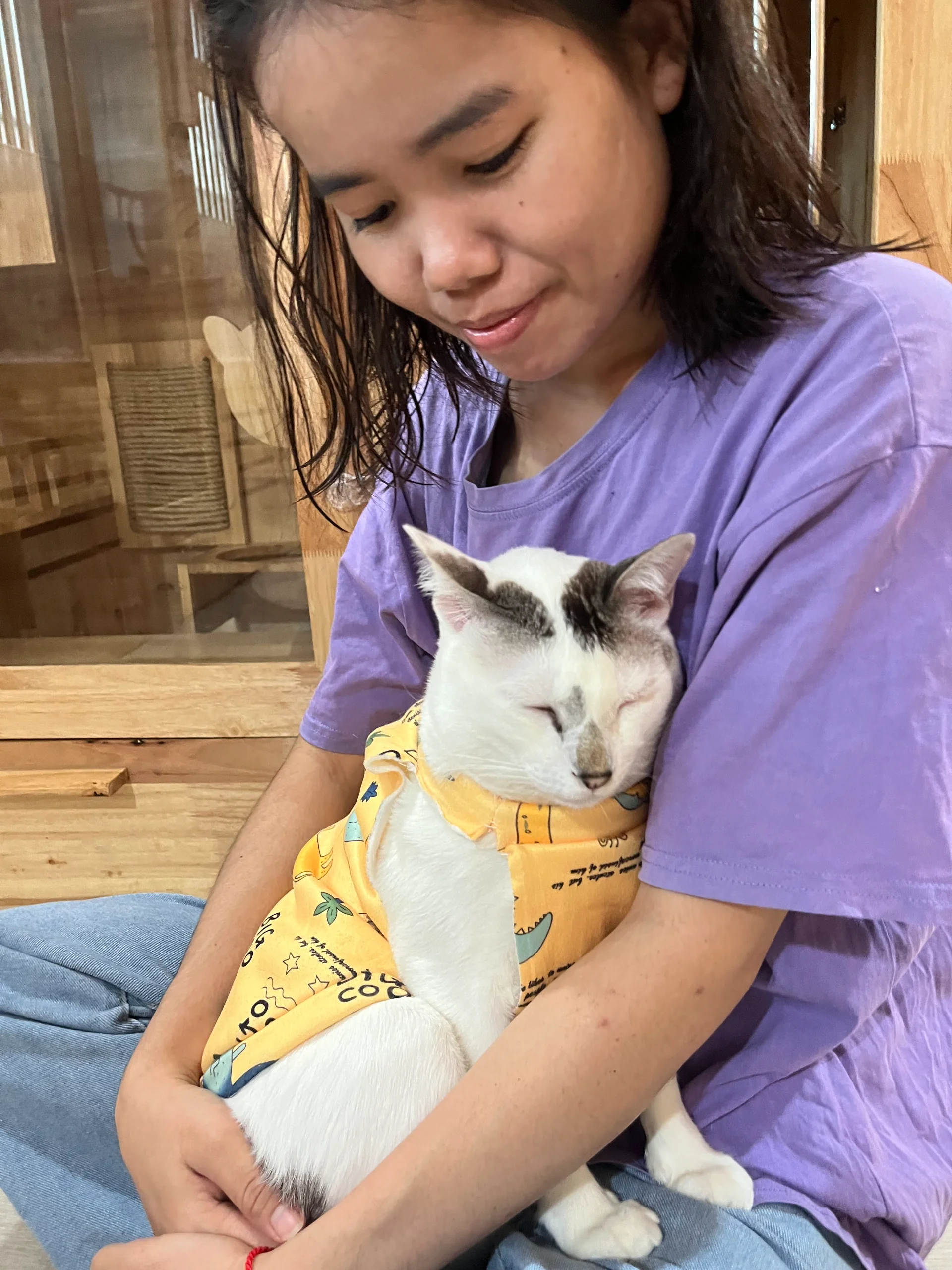
Our owner-led care and 24-hour on-site caregiver presence
Some Cats Hardly Need an Adjustment Period at All
Although this article focuses on the first 2–3 days, not every cat needs that much time.
We have many cats who arrive and begin exploring almost immediately.
Some step out of their carrier and inspect every corner.
Some see a toy and start playing right away.
Some approach the caregiver from the very first meeting.
A cat’s natural personality matters a lot.
Cats who are:
Curious
Social
Interested in exploring
Used to new places
Comfortable with unfamiliar people
may show very little fear at all.
Do Younger Cats Adjust More Easily?
From our experience at Everyday Cat Hotel, many younger cats — especially those under one year old — tend to adjust to new environments quite quickly.
Many still have a strong kitten-like curiosity.
They want to explore.
They want to play.
And sometimes their interest in something new is stronger than their caution.
We therefore see some younger cats who barely need an adjustment period at all.
They arrive on the first day ready to explore and play.
However, this does not mean every young cat will automatically be fearless.
Individual personality and past experience are still more important than age alone.

What About Senior Cats?
For older cats, such as those aged 10 years or above, we sometimes find that they prefer to take a little more time exploring and getting used to the environment.
They may prefer quiet time.
They may not want to play immediately.
Or they may simply need more time to understand the new routine.
That said, many senior cats we have cared for also gradually adjust within approximately 2–3 days.
Our team does not expect older cats to behave like kittens.
Instead, we adapt care according to:
Age
Health
Personality
Need for rest
Interest in people and surroundings
The most important thing is the individual cat’s comfort.
The Second Stay Can Feel Completely Different
One of the sweetest things we see is that many cats who return to stay with us again hardly need to go through the same adjustment process.
Once a cat has already stayed at the hotel, they may remember:
The smell of the place
The environment
The caregivers
The routine
The Playtime areas
And even the room they stayed in before
We have many cats who return for a second stay and show much less fear than the first time.
Some walk in as if they already know where they are going.
And some cats even remember their previous room.
There have been cases where a returning cat was placed in a different room and began vocalizing or acting as if they wanted to go back to the room they remembered.
We see this kind of behavior often enough that it reminds us how strongly cats can build familiarity with both places and people.
For some cats, Everyday Cat Hotel gradually becomes another place they recognize as home.
Familiar Items From Home Can Help a Lot
One of the easiest ways cat parents can help before check-in is to bring familiar items from home.
For example:
A favorite toy
A familiar bed
A blanket
A small cloth
A cushion
Anything the cat regularly sleeps on or uses
Items with familiar smells from home or the cat’s own scent can be especially helpful.
Think about the first day:
Almost everything around the cat is new.
But if there is one familiar-smelling item in the room, the cat still has something they already recognize.
For some cats, simply having their usual blanket or bed in the room helps them establish a safe resting area more quickly.

How Many Toys Should I Bring?
There is no need to bring half the house.
A few familiar items are enough.
For example:
1–2 favorite toys + one familiar blanket or bed
may be more useful than bringing many brand-new toys.
The purpose is familiarity, not filling the room with things.
What to bring for your cat’s boarding stay

Should I Worry if My Cat Does Not Eat on the First Day?
Some cats may eat less or may not eat immediately after arriving in a new environment.
This can happen especially while they are still feeling cautious.
Our team does not look only at whether the cat has eaten.
We also observe the overall picture, including:
Food intake
Water intake
Litter box use
Activity level
Behavior
Response to people
Any other unusual signs
We do not assume that not eating for an extended period is simply normal because the cat is boarding.
If a cat continues not to eat or shows other unusual symptoms, our team will contact the owner and consider the appropriate next steps based on the situation.
What Can Cat Parents Do Before the First Stay?
Beyond bringing familiar items, one of the most helpful things you can give us is information about your cat.
Before check-in, you can tell us:
Whether your cat is normally shy
How they behave around strangers
Whether they have stayed at a cat hotel before
Where they like to be petted
Areas they do not like being touched
Their favorite toys
How they usually play
Where they normally sleep
Their feeding routine
How they behave when stressed
Whether they have ever bitten or scratched when frightened
Any familiar words, names, or ways of calling them
These details may seem small, but they help caregivers understand how to begin building trust with your cat.
Some cats respond well to toys.
Some respond to treats.
Some simply need someone to sit quietly nearby.
Knowing this information in advance reduces unnecessary trial and error during the first few days.
Check our boarding requirements before check-in
If I Am Very Worried, Should I Try a Short Stay First?
If you are particularly worried and have enough time to plan ahead, you may consider starting with a shorter boarding stay before a longer trip.
For example, a few nights before a future long trip.
This gives the cat an experience of:
Arriving at the hotel → staying with the caregivers → being picked up by their family again
When they return in the future, they may remember the environment and the people who cared for them.
However, this does not mean every cat needs a trial stay first.
Many cats can begin with the actual boarding period their family needs.
Remember: Cat Parents Need Time to Adjust Too
During a first boarding stay, sometimes the person who worries the most is the cat parent.
Did they eat?
Are they crying?
Have they slept?
Did they come out to play?
Are they getting comfortable with the caregivers yet?
We understand these concerns very well, especially when it is your cat’s first time staying away from home.
That is why Everyday Cat Hotel provides daily photo and video updates, so you can see how your cat is doing, whether they are beginning to come out of hiding, eating better, playing, or becoming more comfortable with their caregivers.
If you would also like to check on your cat yourself during their stay, you can request CCTV inside the room. The current system allows live viewing through the Mi Home app, and access can also be shared with family members.
For first-time cat parents, CCTV can provide an extra layer of reassurance. You can open the app and see for yourself whether your cat is resting, sleeping, or simply spending quiet time in their room, even between updates from our team.
However, a short look at the camera does not always show the full picture of your cat’s day. For example, opening the camera while your cat happens to be asleep does not necessarily mean they have been sleeping all day.
That is why we see CCTV and daily updates as complementary. CCTV gives you the freedom to check in on your cat yourself, while photos and videos from our caregivers can show other parts of their day, such as Playtime, meals, and interaction with people.
Sometimes, simply seeing your cat sleeping comfortably on the camera — or receiving a video showing that they have started eating and playing — can make it much easier for you to relax and enjoy your own trip too.
Because during a first boarding stay, it is not only your cat who is learning, “Is this place safe?” Cat parents are also gradually learning, “My cat is okay, and someone is here taking care of them.”
View our cat boarding rates and stay options

Can Shy Cats Stay at a Cat Hotel?
Yes.
Being shy does not mean a cat cannot stay at a cat hotel.
What matters is understanding that every cat adjusts at a different speed.
Some need only a few hours.
Some may need 1–2 days.
From our experience, most cats begin getting used to the environment and caregivers within approximately 2–3 days.
Some may need longer.
At Everyday Cat Hotel, we do not rush or force cats to adjust according to our schedule.
We give them time to observe us.
And we also give ourselves time to gradually get to know them.
First-Time Boarding Can Feel Worrying — But It Does Not Have to Be Frightening
For cat parents, the first boarding stay can feel like a big step.
We cannot explain to our cats:
“Don’t worry, I’ll come back in a few days.”
What we can do is prepare them as well as possible, choose a place we trust, and provide the caregivers with as much useful information as we can.
The cat hotel’s responsibility is to gradually help the cat become familiar with the environment without rushing or forcing them.
A cat who watches us from the other side of the room on day one may be walking over to us by day three.
A cat who ignores every toy on the first day may soon be running around the Playtime area.
And when they return for another stay, some cats hardly need to adjust at all.
This is one of the things we love most about caring for cats.
Because the unfamiliar people and unfamiliar place from the first day can gradually become:
people the cat remembers, and a place the cat recognizes.
Frequently Asked Questions
Will my cat be scared during their first boarding stay?
Some cats may be cautious at first because they are surrounded by new people, smells, and surroundings.
From our experience at Everyday Cat Hotel, most cats begin adjusting to the environment and caregivers within approximately 2–3 days.
How long does it take a cat to adjust to boarding?
It varies from cat to cat.
Some adjust on the first day, many begin settling in within approximately 2–3 days, while others may need more time.
What if my cat does not eat on the first day?
Some cats may eat less when they first arrive.
Our team also observes water intake, litter box use, activity, behavior, and other signs.
If a cat continues not to eat or shows other unusual symptoms, we will contact the owner and consider the appropriate next steps.
Can a shy cat stay at a cat hotel?
Yes.
Our caregivers gradually adjust their approach to each cat without rushing or forcing interaction, allowing the cat to become familiar at their own pace.
Should I bring things from home?
Yes, familiar items can be helpful.
A bed, blanket, small cloth, or favorite toy that carries familiar smells can help give the cat something recognizable in a new environment.
Do younger cats adjust more easily?
From our experience, many cats under one year old adjust relatively quickly because they are curious and playful.
However, personality is still more important than age alone.
Can senior cats stay?
Yes, provided the cat meets the hotel’s current boarding health and eligibility requirements.
Some senior cats may take a little more time to settle, but many also gradually adjust within approximately 2–3 days.
Will my cat remember the hotel if they come back again?
From our experience, many returning cats show much more familiarity than they did during their first stay.
Some remember the caregivers, the environment, and even the room they stayed in before.
Will caregivers force my cat to come out and play?
No.
For cautious cats, our team does not force Playtime or unnecessary interaction.
We gradually increase contact according to the cat’s comfort level.
First-Time Cat Boarding at Everyday Cat Hotel
Everyday Cat Hotel follows an Owner-Led Home Care approach, with the owner closely involved in day-to-day care and a caregiver living within the same building as the hotel during both the day and night.
We have experience caring for more than 1,000 cats, from cats who need several days to build confidence to those who step out of their carrier ready to explore immediately.
One thing that experience has taught us is:
There is no single approach that works for every cat.
Our job is not to force cats to adjust to the hotel as quickly as possible.
It is to gradually get to know them, give them time, and adapt our care to their individual personality.
If you are planning your cat’s first boarding stay, have a shy cat, or are simply worried about how they may adjust, you are always welcome to tell our team about your cat before the stay.
Explore our private cat room options
Learn more about Everyday Cat Hotel
LINE Official: @everydaycathotel
Phone: 099-225-2215
Website: www.everydaycathotel.com


